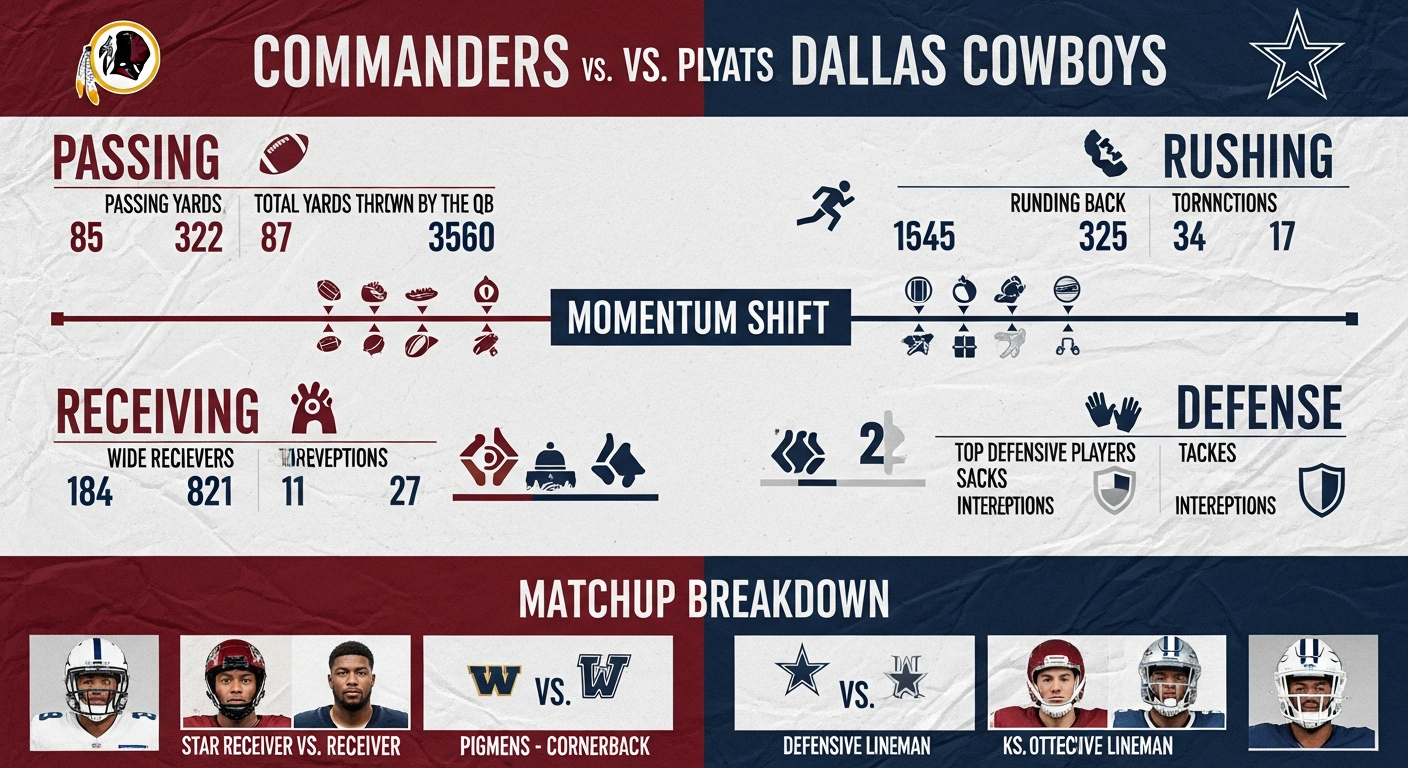
Washington Commanders vs Dallas Cowboys Match Player Stats
A fierce rivalry always brings drama. Consequently, fans search for clarity on who produced, why momentum shifted, and which matchups tilted the field. This guide focuses on Washington Commanders vs Dallas Cowboys Match Player Stats with crisp breakdowns, practical definitions, and ready-to-use insights that transform raw box numbers into confident decisions and smarter conversations. Snapshot…
A fierce rivalry always brings drama. Consequently, fans search for clarity on who produced, why momentum shifted, and which matchups tilted the field. This guide focuses on Washington Commanders vs Dallas Cowboys Match Player Stats with crisp breakdowns, practical definitions, and ready-to-use insights that transform raw box numbers into confident decisions and smarter conversations.
Snapshot and Context for washington commanders vs dallas cowboys match player stats
Rivalry games compress margins. Therefore, single plays swing outcomes and inflate narratives. However, player stats reveal repeatable edges. Track success rate, early-down efficiency, and explosive play rate to separate luck from skill. Additionally, compare offensive EPA per play against defensive EPA allowed to contextualize production.
Team tendencies matter because they shape opportunities. For instance, a quick-tempo script spikes target counts for slot receivers, while condensed formations feed tight ends near the sticks. Moreover, neutral-situation pass rate predicts volume more reliably than scoreboard-driven spurts. Consequently, pair volume metrics with efficiency to avoid box-score traps.
Role stability wins over one-off spikes. Thus, snap share, route participation, and designed touches validate usage. Meanwhile, red-zone involvement translates into points, not just yards. Furthermore, align individual outputs with coverage shells faced, pressure frequency, and blitz pickup success, since those inputs forecast sustainability across future matchups.
Quarterback Metrics and Efficiency
Quarterbacks drive narrative and numbers. Therefore, start with completion percentage over expected (CPOE) to gauge accuracy beyond difficulty. Additionally, blend it with EPA per dropback to capture down-to-down value. When both sit above league average, the passing game usually sustains drives and widens schematic options.
Pressure performance separates good from great. Consequently, chart time-to-throw, pressure-to-sack rate, and scramble EPA to understand resilience. Moreover, check play-action rate and under-center usage, since defenders hesitate when run threats look credible. As a result, intermediate windows open, and yards per attempt climbs without reckless deep-ball dependency.
Turnover-worthy play rate refines interception stories. Sometimes picks bounce off hands; sometimes defenders drop gifts. Therefore, rely on graded turnover risk rather than raw interceptions. Additionally, note third-down conversion rate and two-minute effectiveness, because clutch sequences amplify the scoreboard impact of every accurate throw.
Ground Game and Red-Zone Rushing
Rushing success steadies tempo. Consequently, prioritize success rate over yards per carry, which often swings on one long run. Additionally, short-yardage conversion reveals interior push, while yards after contact per rush spotlights tackle-breaking. Together, these situational stats explain why some backs thrive despite modest raw yardage.
Blocking sets the ceiling. Therefore, evaluate stuff rate, line yards, and gap-scheme versus zone efficiency to see how fronts create lanes. Moreover, examine motion at the snap, because moving chess pieces widens angles. As a result, backs hit the line cleaner and keep the offense ahead of schedule.
Red-zone rushing unlocks finishers. Thus, log carries inside the ten, missed tackles forced, and rushing EPA in condensed space. Additionally, track quarterback keepers from option looks, since those steals convert hidden touchdowns. Consequently, total team rushing TD probability rises, even when a single back lacks headline totals.
Pass Catchers and Coverage Matchups
Targets tell the story first. Therefore, record target share, first-read rate, and yards per route run to grade primary options. Additionally, route depth matters; average depth of target (aDOT) signals role type. As a result, complementary receivers benefit when defenses bracket alpha threats on key downs.
Coverage shapes outcomes as much as talent. Consequently, isolate performance versus man and zone, then layer slot versus boundary splits. Moreover, chart separation at throw and contested-catch win rate to verify consistency when windows shrink. Therefore, a receiver with modest separation but elite win rate still projects strong.
Tight ends punish mismatches. Thus, compare in-line versus detached alignments, play-action targets, and seam usage. Additionally, backs in the passing game flip leverage through angle and wheel routes. Consequently, linebackers hesitate, and check-downs morph into chunk gains that sustain drives while tiring the pass rush.
Defense, Pressure Rate, and Turnover Windows
Defenses tilt the field by shrinking time. Therefore, highlight pressure rate, quick-pressure percentage, and pass-rush win rate before sacks. Additionally, chart stunts and simulated pressures, since they create free runners without coverage sacrifice. Consequently, hurried throws carry lower accuracy and higher turnover probability.
Run defense begins with fits. Thus, examine run stop win rate, average depth of tackle, and missed tackles per attempt. Moreover, early down run success allowed dictates third-down distance. As a result, pass rushers earn favorable situations, and defensive coordinators access deeper blitz packages without explosive-play risk.
Coverage integrity seals drives. Consequently, review zone match discipline, forced incompletion rate, and yards allowed per coverage snap from corners and safeties. Additionally, turnover opportunities spike when pressure and sticky coverage combine. Therefore, tipped balls, strip sacks, and route jumps appear as predictable outcomes rather than surprises.
Special Teams, Coaching, and Situational Edges
Hidden yards decide close games. Therefore, log average starting field position, punt hang time, fair-catch rate, and kickoff return avoidance. Additionally, reliable kicking from forty to fifty yards stabilizes fourth-down choices. Consequently, coordinators call more aggressive sequences, knowing three points remain accessible afterward.
Coaching inputs translate to numbers. Thus, script strength across first fifteen plays often forecasts early leads. Moreover, fourth-down decision aggressiveness, time-out stewardship, and two-point attempt logic compound over sixty minutes. As a result, a few percentage points of win probability emerge from process, not just star talent.
Situational mastery shows up in success rate at key moments. Therefore, isolate third-and-medium, two-minute drill, red-zone defense, and backed-up possessions. Additionally, track penalties by down and distance, because free first downs extend opponent drives. Consequently, clean teams protect leads while error-prone units invite comebacks.
Conclusion
Numbers tell the truth when you read them in context. Therefore, combine usage, efficiency, and situation to decode washington commanders vs dallas cowboys match player stats with confidence. Additionally, apply these frameworks each week to separate noise from signal. Act now, update your notes, refine your model, and share your insights.
FAQs
Which quarterback stats matter most for this matchup?
Accuracy over expectation and EPA per dropback combine volume with value. Moreover, third-down conversion and pressure-to-sack rate show resilience. Additionally, turnover-worthy play rate clarifies risk beyond interceptions. Therefore, those four pillars best explain sustained drives, red-zone chances, and closing efficiency late.
How should I compare wide receivers across both teams?
Start with target share and yards per route run, since they unify opportunity and efficiency. Additionally, add aDOT to define role depth. Furthermore, evaluate performance versus man and zone to anticipate defensive responses. Consequently, the cleaner profile usually tracks the higher weekly ceiling.
What rushing indicators predict success here?
Success rate beats yards per carry for stability. Moreover, line yards and stuff rate indicate trench control. Additionally, red-zone attempts inside the ten forecast touchdowns. Therefore, a back with steady success and high-leverage carries presents superior reliability, even when explosive runs remain limited.
Which defensive stats forecast turnovers?
Turnovers follow pressure plus disciplined coverage. Thus, prioritize pressure rate, quick-pressure percentage, and forced incompletion rate. Moreover, tipped passes and strip attempts rise when rush and coverage synchronize. Consequently, takeaways stop drives, flip field position, and produce short-field scoring opportunities for efficient offenses.
How do coaching decisions enter the stat picture?
Play-calling aggressiveness transforms expected points. Therefore, fourth-down choices, early-down pass rate, and two-point math push slim edges. Additionally, time-out usage preserves drives, while scripted starts set rhythm. Consequently, well-timed decisions nudge efficiency metrics upward and convert narrow margins into tangible scoreboard advantages